
Blog > From Wine Bottles to CEO: How Brian Shepard Plans to “Shepard” MTNA Into the Future

By Richard Rejino
As MTNA celebrates its historic 150th anniversary, we're looking back through the eyes of our past presidents and other leaders, inviting them to reflect on the challenges they faced, the accomplishments they achieved, and their hopes for the future of the association and the profession. All leaders are interviewed and photographed by MTNA member Richard Rejino.
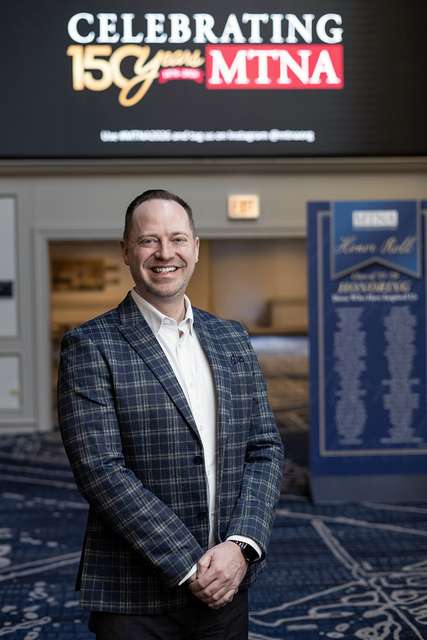
Who would have thought that opening a few wine bottles would predestine someone to become CEO of the oldest association for music teachers in the country? It doesn’t seem very likely, does it? Not even in Hollywood. But that’s exactly what happened to Brian Shepard. Like many of you, I’ve enjoyed knowing Brian for as long as he has been with MTNA. As part of this series of articles celebrating MTNA’s 150th anniversary, we spoke about what led him to the association and his vision for its future.
No matter what anyone says, being the leader of any organization changes how people perceive you. You may have been the most popular person in the office before, but when you’re suddenly the one in charge, people look at you differently. So, after nearly a year in his new role, I was curious to see how Brian was adjusting. Our conversation was as fun as it was fascinating. It touched on important events and life decisions that revealed just how much the stars aligned for Brian to serve a major leadership role at MTNA. His responses to my questions were clear-eyed and forward-thinking; and, true to form, it was heartening to see that he hadn’t lost his sense of humor and joyfulness (… more on the wine bottles later).
For many members, it’s hard to imagine a time when Brian wasn’t a part of MTNA. It feels as if we’ve known him since he was a fresh-faced college graduate. He and I first met shortly after he started working for MTNA. I was a retail print music store owner at the time, and when I needed visual aids for a presentation I was making called “Piano Teachers Gone Wild,” Brian delivered some hilarious photos. His enthusiasm and can-do spirit were impressive.
Over the next 23 years, Brian worked in various positions. His work ethic, infectious energy, and positivity stood out—to say nothing of his charm and megawatt smile. But to really understand why he is the perfect person to lead the association at this moment, it’s important to understand the arc of his music education and how his lifelong ties to MTNA predestined him to where he is today.
Brian’s connection to the association began when he was in elementary school. He was born into a family that deeply valued music education, his parents insisting everyone study music. All five family members learned piano with the same teacher, Marilyn Adams (an MTNA member). Through his lessons, Brian became familiar with MTNA at the local level. He also studied voice in high school and was in the choir, band, and show choir. Coincidentally, his piano and voice teachers also happened to teach Shirley Raut, MTNA executive director at the time. Later, he attended Miami University and majored in piano and voice education and was a collegiate member of MTNA. As fate would have it, he discovered he wasn’t really cut out to be a high school choir director, but the nonprofit world of arts management appealed. So, he decided to pursue a degree in marketing, too.
Popping Corks?
But back to the wine story.
In another coincidence, while in college, Brian’s friend and a former MTNA employee, Jennifer Bellin, was organizing a reception at the Cincinnati Conservatory. She asked Brian for help. His first duty was to open some bottles of wine, at which he showed an impressive facility (or so I’m told). It was at this event he first met Gary Ingle, executive director from 1996–2024. When Jennifer later invited Brian, now a recent graduate with degrees in music education and marketing, to help with the reception again, it set the stage for an unexpected career opportunity: She later asked whether he had a résumé because Gary wanted to discuss some marketing ideas with him. Brian had been working as assistant manager at a GAP store, but as he fondly recalled, “I didn’t want to be in charge of folding jeans the rest of my life, even though I did have a great wardrobe!”
After meeting with Brian, Gary Ingle was so impressed that he created a role for him as director of marketing and public relations. It was a dream job. In the next few years, it expanded to overseeing IT and accounting while gaining important project management experience. And every time Brian felt restless and the urge to explore other prospects, a new opportunity at MTNA would drop in his lap: “little” things like being promoted to COO in 2008 and, in 2024, to CEO.
I asked him the secret to his success: “I think the fact that I had a safe environment to grow and learn as a professional was huge,” he replied. “I was able to take some calculated risks and learn from them. They taught me to be more patient and understand how to move an organization forward.”
He also credits Gary Ingle for his ability to recognize and nurture Brian’s strengths. “It’s been an incredible ride,” he added. “I wouldn’t trade my journey for the world. Working with websites, budgets, creating efficiencies, and so much more has been professionally and personally valuable.”
 Challenges and a Vision for the Future
Brian was quick to articulate his goals and vision for MTNA. To begin, he clearly understands MTNA is a legacy organization, and he is determined to preserve that legacy moving forward. But he is also keenly aware that the association must continually evolve to remain relevant, especially in today’s fast-paced, ever-changing world.
MTNA is not unlike other nonprofit member associations. It faces the same challenges: keeping up with trends, with AI opportunities and pitfalls, social media, and shifting societal attitudes—to name a few. He says, “Growing membership, creating improved member resources and benefits, and building a community that welcomes diversity in all its forms, has never been more important.”
Meeting these challenges successfully requires a lot of listening and input from every corner of the association. As Brian put so fittingly, “My biggest challenge every day is trying to determine the best use of our resources, despite there being so many good ideas,” he said. “I don’t ever want to dampen the spirit of people in MTNA. Sometimes I feel like a dark cloud because we must learn to say ‘no’ to good ideas and ‘yes’ to great ideas.”
I posed the question of what MTNA is doing to address the challenges confronting today’s independent piano teacher and what advice he would give to a young or beginning teacher.
“First, I have to say that for 23 years I have seen MTNA evolve. It has become a professional and global entity, and we’ve created a framework to include assets and resources to ensure we have a long-term future. I’m very proud to have been a little part of creating and continuing that legacy,” he said.
“As more teachers see independent teaching or starting a music school as a full-time career, we are very proud of the MTNA Business Digest and the Business Resources Library on our website. We’re trying to fill in the gaps that formal education doesn’t teach, such as business skills, marketing plans, budgets, etc., and we’re doing that with webinars, a great resource library, and a quarterly digital newsletter.”
As Brian continued, he noted that many pieces for sustainability are already in place but added, “we just have to continue listening, adapting, and responding to the needs of our members.” Another important piece of the framework that he is quick to point out is the talent, diversity, and longevity of the MTNA staff, many of whom have been with the organization for over 20 years. “I think it speaks volumes about the mission and commitment to what we are doing at MTNA,” he said.
Advice for the Young or Beginning Teacher
Starting out in any business is never easy and an independent music teacher has its own set unique issues. Brian believes there is safety in numbers: “I think finding your people is so important. Every teacher, new or experienced, needs to connect with a music teaching community like MTNA. Some of the best conversations I’ve had over the years have been with colleagues. I’ve learned so much from listening to other teachers.”
He stressed the importance of being proactive in their career. “I think teachers should always be on the lookout for opportunities and make something of them. Look at me, who knew that opening bottles of wine would lead me to become CEO!”
“To a certain degree, you have to make your own destiny. I urge teachers to get out and volunteer, introduce themselves to people in the community, and be ready to help. Remember that everything has its season. Things change, and there will be ups and downs, but we need to take responsibility for our circumstances. We all need to be good team members and rise above the unpleasantness.”
The North Star
Having a strong belief in an organization’s mission, passionate staff, and members who work together toward its common goal are essential ingredients for longevity. In this sense, Brian highlighted that MTNA has already taken steps to help teachers feel part of the community. “My vision as CEO,” he says, “is making sure that MTNA is the one thing music teachers can’t live without. Teachers need a home, and that means people at all levels need to feel welcomed, no matter what their background is: ESL, artist-teachers, or teachers in the trenches. We want MTNA to be a place where everyone can come and grow and learn from one another, as well as a place where they contribute and give back.”
As a leader, Brian is emotionally invested in his work, and as a result, his professional and personal life often intertwine. He has made many lasting friendships with teachers and staff over the years, many of whom have impacted him in significant ways. I asked him to share one such person.
“When I think of some of the teachers I’ve met, I always remember Aurelia Campbell. She used to come to every single conference and was so dedicated to MTNA. What struck me about her was her spirit and the pride of being involved with MTNA. She was never a famous teacher, but she really struck my heart because she was excited about what she did. She has really shaped me personally. She represents what I wish for every member.”
To balance his daily challenges with his long-term goals, Brian regularly “zooms out” and thinks about the real mission and purpose behind his calling to lead. “Ultimately,” he says, “I want MTNA to reach 300 years. To do that as a leader, I have to always be learning and opening myself to new things. It’s important for me to not just preach to our teachers about professional development but for me to do it, too.
“As a leader, I don’t see myself as needing to know everything or be an expert on everything, but I need to know how to connect people. An important part of leadership is knowing what your strengths and weaknesses are and surrounding yourself with people who know the things you don’t know.”
Legacy
Indeed, MTNA is fortunate to reach its 150th year. By and large, it has enjoyed strong leadership and the good fortune of having had the right people in the right place at the right time. Undoubtedly, it will face unknown challenges, but if the past is prologue, then the association is prepared for whatever may come.
As we ended our conversation, I asked Brian what his northern star will be as he “Shepards” the organization into the future. He thought for a moment and said he was constantly inspired by the people around him who dedicate themselves to making a difference. “Most importantly, I’m proud of thousands and thousands of students our members are teaching daily and making their lives better. Our members are really making a difference whether they teach ten or a hundred students. Students’ lives are being impacted positively because of them. That is the most important thing to remember about MTNA and what I’m most proud of.”

Richard Rejino is a member of MTNA and a writer and photographer based in Dallas, Texas. He is the author of What Music Means to Me, and his writing and photography have been published in national and international publications.